In an increasingly digitized world, the concept of soundscapes has evolved beyond natural environments to embrace the synthetic. Environmental sampling, once a niche technique in music production, has burgeoned into a sophisticated method for constructing rich, immersive electronic soundscapes. This practice involves capturing real-world sounds—from the rustle of leaves to the hum of urban infrastructure—and transforming them into the building blocks of auditory art. The resulting compositions are not merely background noise; they are intricate tapestries that reflect, reinterpret, and sometimes reimagine the acoustic environments from which they originate.
The process begins with field recording, where artists and sound designers venture into diverse locales armed with high-quality microphones and portable recorders. These excursions are as much about serendipity as they are about intention. A chance encounter with a resonating bridge or the rhythmic patter of rain on a tin roof can yield samples that become the cornerstone of a new piece. The authenticity of these recordings provides a tangible connection to reality, even as they are later manipulated beyond recognition. This duality—rooted in the real yet aspiring to the abstract—is what gives sampled electronic soundscapes their unique emotional resonance.
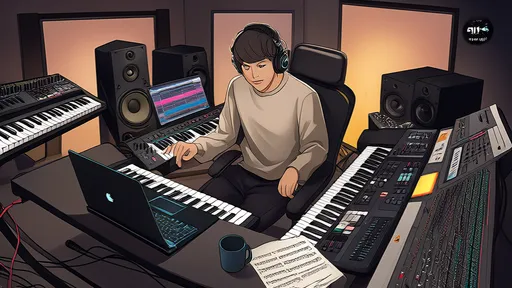
Once captured, these raw recordings undergo a metamorphosis through digital audio workstations and specialized software. Techniques such as time-stretching, pitch-shifting, and granular synthesis allow artists to dissect sounds into their constituent parts and reassemble them in novel ways. A fragment of a bird's song might be slowed down to reveal hidden harmonics, or the crackle of a fire could be layered into a percussive rhythm. The tools at hand are powerful, but the artist's sensibility dictates the outcome. It is a marriage of technology and creativity, where each processed sample carries the ghost of its origin while serving a new artistic purpose.
The applications of these constructed soundscapes are as varied as the sources themselves. In multimedia installations, they create immersive environments that respond to viewer movement or input. In film and video games, they enhance narrative depth, providing auditory cues that ground fantastical elements in a semblance of reality. Even in everyday contexts, generative soundscapes—built from samples and algorithms—can transform public spaces or provide personalized sound environments for focus or relaxation. The flexibility of the medium means that it can be tailored to evoke specific emotions or reactions, making it a potent tool for storytellers and experience designers alike.
Despite its technical underpinnings, the art of building electronic soundscapes from environmental samples is deeply human. It reflects a desire to capture and recontextualize the fleeting moments of acoustic beauty that surround us. In a world where silence is increasingly scarce, these compositions invite listeners to engage with sound more intentionally. They remind us that music is not confined to traditional instruments or scales but can emerge from the very fabric of our daily lives. As technology continues to advance, the possibilities for this fusion of environment and electronics will only expand, offering new ways to hear—and shape—the world around us.

By /Aug 22, 2025

By /Aug 22, 2025

By /Aug 22, 2025

By /Aug 22, 2025

By /Aug 22, 2025
By /Aug 22, 2025
By /Aug 22, 2025
By /Aug 22, 2025
By /Aug 22, 2025

By /Aug 22, 2025
By /Aug 22, 2025

By /Aug 22, 2025
By /Aug 22, 2025
By /Aug 22, 2025
By /Aug 22, 2025

By /Aug 22, 2025

By /Aug 22, 2025

By /Aug 22, 2025

By /Aug 22, 2025

By /Aug 22, 2025
